Microfading Tester International Discussion Group

 View Only

 MFT of Varnished vs. Unvarnished Wood

Grace Wilkins's profile image
Grace Wilkins posted 05-07-2025 12:59

Hi All, 

My name is Grace Wilkins and I am a graduate conservation intern at the J. Paul Getty Museum. My supervisor, Arlen Heginbotham, and I are interested in measuring the light sensitivity of woods commonly used as veneers on European furniture. The museum is exploring the possibility of displaying a number of furniture pieces with doors or compartments open, and we were hoping to use MFT to gain a better idea of appropriate light dosages for interior surfaces that have had relatively little past light exposure.

As of now, we have conducted preliminary runs on a set of "reference" coupons of 8 different woods using a Whitmore setup. Sections of the coupons have been varnished with two coats of a nitrocellulose-based lacquer to mimic the finishes found on many of the collection objects in question. We have not had any major issues with running the setup on the unvarnished areas, but are having difficulty getting consistent, stable results withs runs on the highly reflective, varnished areas; the deltaE00 graph jumps up and down and does not give any semblance of a trend or curve, even after recalibrating to the spectralon or switching to a different location on the sample. 

I am curious to see if anyone has experienced this when conducting MFT on reflective, coated or varnished materials (wood or otherwise). If so, is there a consensus as to what might be the cause of this lower quality/inconsistent data, and are there any recommendations as to how we can modify our setup and/or acquisition parameters to mitigate these effects?

While the unvarnished portions do provide some helpful reference data, being able to generate successful runs on the varnished sections has important implications as to whether or not we can expect to collect useful data from the varnished, veneered objects in situ.

Any thoughts or suggestions would be much appreciated.

Thanks, 

Grace

Michael Crawford's profile image
Michael Crawford

Hi Grace,

What do the reflectivity spectra look like for the uncoated and coated wood samples?

Best regards,

Mike Crawford

Grace Wilkins's profile image
Grace Wilkins

Hi Mike, 

Here is an example of the spectra for Mahogany. The first graph shows unvarnished samples, the second shows the runs on the varnished sections. 

Unvarnished Mahogany (2 run; #1, #3):

Varnished Mahogany: (3 runs; #4, #5, #6)

In looking at the DE*00 graph (below), and the varnished spectra (above), it appears that the issue might be related to the low %reflectance (and lower signal/noise ratio) for one of the three varnish runs. If so, it is not clear to me what exactly about the varnish layer is responsible for this huge shift in signal intensity between similar-looking varnished areas. I had similar results running the varnished areas of the Purpleheart sample as well, and am not sure how to control for this shift or avoid it.

Any thoughts on this would be much appreciated!

Thanks, 

Grace

JP Brown's profile image
JP Brown

Dear Grace

It looks to me as though you have some noise in the <400 nm range. That could be significant where you have low reflectance for one of the nitrocellulose samples. Take a look at the SPD that you took for the Spectralon standard (i.e., the SPD after the dark correction). I'd be interested in whether there's much signal below 400 nm.  Rule of thumb is not to use areas of the SPD where the white reflectance is <5% of the highest reflectance in the SPD.

If lack of signal is the issue, you could try re-running the file import to SpectralViewer with different properties on the spectral filter. (Edit > Properties> and then something like this...)

On the lack of signal in one of the nitrocellulose runs (hard to tell which one it is from the colors on the chart), I think you may be looking at either 

  • a focusing issue, or
  • a bad return fiber, or 
  • a bad return fiber connection, or
  • white reference taken before dark correction, and dark correction applied afterwards

but I assume that you have ruled all these out already. I don't have anything more helpful to suggest at the moment, but I will think on it some more. One possible approach to debug the issue, if you are not already doing this, would be to use a cheap and cheerful digital microscope (like this one) in order to look in detail at the surface where the spot is focussed to check for anything obviously weird about the surface where you are taking the reading. What I'm thinking here is that you may be taking a reading at a pit in the mahogany surface, but actually focusing on the top of the varnish layer. You would want the spot focused at the wood surface, rather than at the top of the varnish layer.

JP

Michael Crawford's profile image
Michael Crawford

Hi Grace,

I agree with you and JP that the very low reflectivity of that one (coated) sample is the problem. JP suggested a number of possible causes and solutions for this. 

A few more questions:

How often have you encountered such low signals from your wood samples? Only on varnished samples? Is this one sample an outlier?

How do you determine when best focus is achieved? Visually or by maximizing the signal? 

How thick are the varnish layers? How uniform are they?

We have seen similar noisy data at Winterthur on low reflectivity textile samples, and as JP has suggested it can be improved by truncating the spectra to eliminate a noisy region where the lamp/filter combinations yield a low light intensity (see example below). Of course, too much truncation might also affect the accuracy of color determination. 

Here is a low reflectivity sample with noisy data below 420 nm:

Truncating the data at 420 nm improves the S/N of the deltaE00 graph:

You could also try increasing the spectrometer integration time/number of scans for samples with weak signals if other fixes don't help (it looks like there is digitization noise in the spectra, although it is hard to be certain without rescaling the graphs).

I hope this helps!

Best regards,

Mike

Christel Pesme's profile image
Christel Pesme

Dear Grace,

While I agree with JP and Michael answers, allow me to add few comments, hoping it can be useful for your research.

1-       Wood is an anisotropic material, that is the %R measurement and subsequent La*b* depends on orientation between the surface and measurement plans. While this should not impact the MFT results obtained too much, you may however wish to keep an eye on it to achieve an higher level of consistency of your results

2-       Can you confirm that the most unstable MFT measurement corresponds to the lowest %R ( i.e the %R  almost null across the visible range )? If this is the case, i would suggest to consider the % R measurement  abnormal and discount the MFT result as alreay suggested by JP.

3-       Regarding the higher level of uncertainty associated to measured low signal. While true in both cases, it is nonetheless beneficial to distinguish at least 2 situations:

a-       When the measured low signal results from measuring the light reflected by a surface significantly absorbing parts of the incident light, in other words by a surface perceived as dark.

b-       When the measured low signal results from the reflection by a surface of an incident light lacking some parts of the visible range in its SPD, like it can be the case with LED white source. The surface measured does not have to absorb a lot for the measured signal to be low.

In the latter case, the induced uncertainties will likely much larger considering how the signal is computed in the CIE XYZ space as the ligth source tristimulus values are used as dividers to derive the La*b* coordinates of the measured surface.

It would be recommended to characterise the SPD of the source you are using, especially in case a LED white lamp is used as a source.

4-       Finally, if I am not wrong the varnish you are using seems both transparent and colorless (resulting in saturating the wood color when observed away from the gloss direction):  that may only be sensitive to blue-UV light when fresh, while yellowing after thermal aging and consequently potentially becoming more sensitive to the blue part of the visible range. Depending on what you want to test, you may wish to consider also exploring this aspect.

I hope this helps ! Good luck for your research and keep us updated.

Best regards

Christel

Oliver Orr's profile image
Oliver Orr

Hi Grace, 

Oliver Orr from the Metropolitan Museum of Art Department of Textile Conservation, here. I'm relatively new to micro fade testing and have had a somewhat similar issue. We recently loaned the use of our MFT to colleagues in another department who were looking at a 19th-century bark manuscript from Indonesia. Portions of the pages were coated in a yet-to-be-identified shellac- or varnish-like coating, and other portions looked uncoated. While MFT readings of each section revealed similar aging trends (both reaching a dE2000 of about .3 after 1 Mlux*h), there was much less noise in the un-coated portion of the page. 

Out of curiosity, we once took readings of the same textile behind a layer of anti-glare Plexiglas and with the Plexiglas removed, to test the feasibility of taking MFT measurements of textiles that are too fragile to remove from pressure mounts. We found a similar result: that the aging curve follows roughly the same trendline, but with a higher signal-to-noise ratio when there's no reflective surface or coating in between. 

These are obviously not scientific results, and they are in hindsight somewhat intuitive, but we found it nevertheless interesting to note. We often struggle with getting good measurements with little "jitteriness" in the curves/trendlines because of the surface and materiality of the objects we look at (we assume), and "reflectiveness" is something we now realize we need to consider. 

It has been enlightening to read everyone else's replies regarding the spectra; I will be certain to keep these issues in mind. Thank you! 

The discussed measurements were all taken with an Instytut Fotonowy MFT. 

Grace Wilkins's profile image
Grace Wilkins

Hi Everyone,

Thank you for such thorough and thoughtful responses! This has given us a lot to discuss and think about, and I will be sure to update this thread as we continue acquiring more reference data in the coming weeks.

I will have to check the Spectralon standard SPD again when I go to run more samples on the Whitmore, as I am not sure about the noise in the <400nm region, but that 5% rule of thumb is good to know going forward.

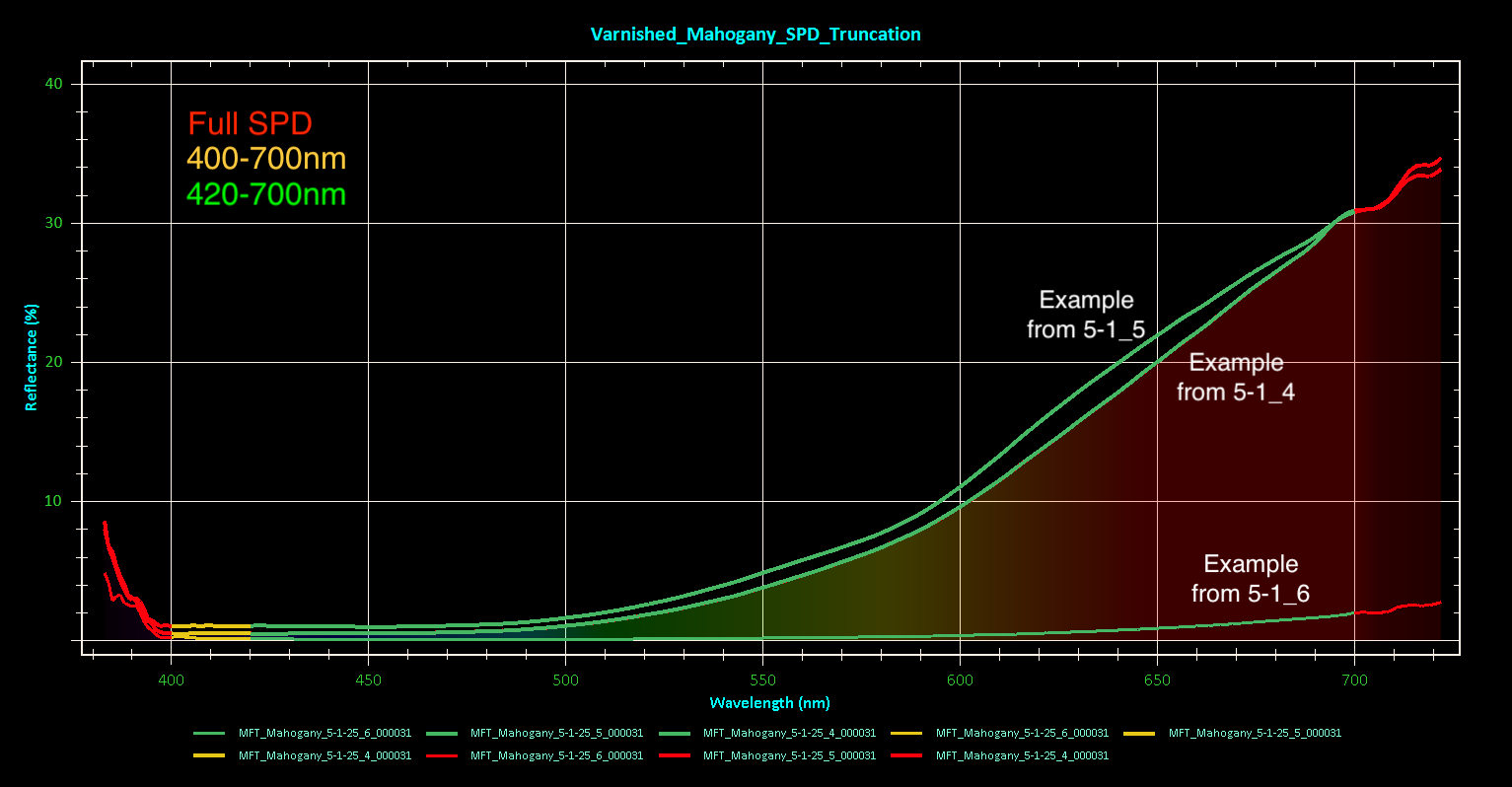
To answer Christel’s question about %R and measurement instability, yes, the lowest %R spectra appear to be the least stable (Sample 5-1_6, shown below, being the clearest example).

The SPD truncation you all suggested appears to make the greatest difference with the lowest %R varnished sample run (5-1_6), though not as much as what Mike’s DE*00 graph showed. Perhaps that is simply a result of fewer sampling intervals over a shorter runtime on my end. 
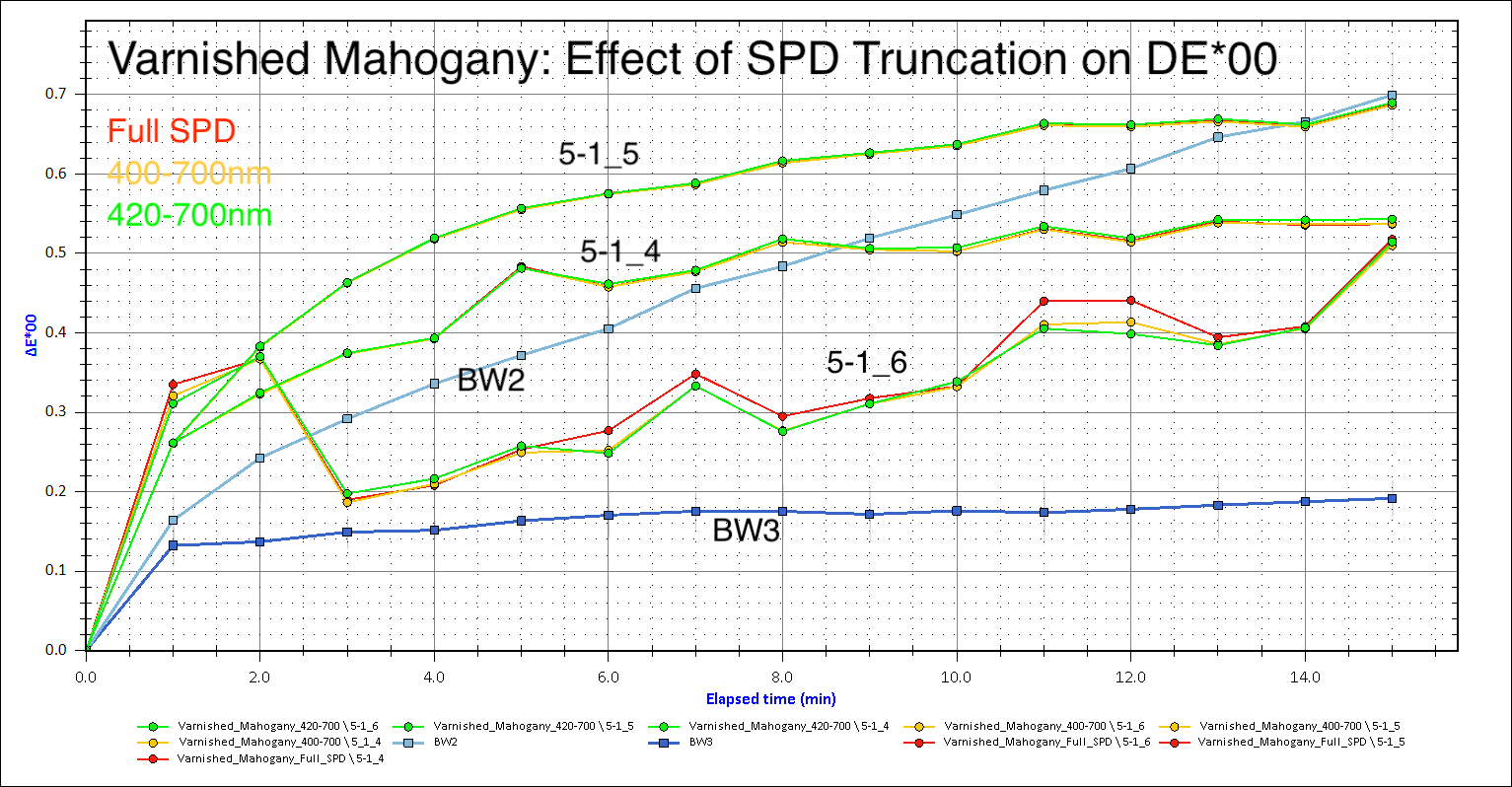
I agree that the case of 5-1_6, it may simply be too low of a %R to be considered usable data. To answer Mike’s question, this kind of scattered, low S/N spectra only occurred on the varnished areas, and happened with some frequency. I generally ended up stopping the run and choosing a different location when I could tell the run was low signal and/or unstable DE*00, thus I don’t have many complete 15min run SPDs to compare to the full, successful runs (varnished or otherwise). 

It is good to know that this instability occurring only with the varnished areas is consistent with what Oliver mentioned with MFT of the coated and uncoated manuscripts and the MFT runs through Plexiglas. Similarly, the overall curve of the better, higher %R, varnished veneer runs (i.e 5-1_5) was relatively consistent with the aging trend indicated by the corresponding unvarnished runs (not shown in the graphs here).

In terms of sample location, we do have a dino-lite USB microscope that I agree might be helpful in selecting better (smoother, unpitted) areas of the wood coupons for testing. The varnish layer is relatively thin and uniform (two brush-applied coats), though what appear to be small variations in thickness may have a greater effect at the scale at which the data is being collected.

Within our existing protocol, best focus is achieved visually (switching the spectrophotometer fiber to a secondary input light source and lowering/raising the MFT head such that both beams are centered over each other). This likely results in focusing at the top of the varnish layer, as opposed to the underlying wood surface, which is something that JP mentioned might be an issue. Would focusing by maximizing signal allow for us to focus specifically on the wood surface? How would I go about doing this without prematurely exposing my sample location to the full lamp intensity?

Finally, just to confirm, how (and in what direction) would adjusting the integration time be beneficial for low %R/weak signal samples? I see how increasing the number of scans would help, but I am less clear on integration time.

Thank you all again for your thoughts and suggestions!

Best,

Grace  

Michael Crawford's profile image
Michael Crawford

Hi Grace,

You can increase the integration time if the signal is below the dynamic range of the spectrometer/Si photodiode array. The Control Development PDA has a 16 bit A/D converter, so the maximum signal before saturation is 216 = 65,536 counts. You can look at the number of counts (not % transmission) for your low reflectivity samples and if it is much lower than this value you can increase the integration time to increase the signal (and S/N). Increasing the number of scans also improves the S/N, but I think it is worth adjusting/optimizing the integration time as well. Noise contributions such as array readout noise increase with the number of scans, but not with the integration time.

Your focusing technique is fine (we do the same), but maximizing the signal is also worth trying. Since the Whitmore MFT uses 0/45 geometry, the specular component due to reflection from the varnish surface will return along the incident beam path and will not be seen by the signal collection fiber, but the diffuse component (which has the color information) is more broadly and thus diffuse reflected light will enter the collection lens/fiber and be transmitted to the spectrometer. So maximizing the signal should maximize this diffuse component, which comes primarily from the wood surface. The two focusing methods (two beam overlap vs signal level) should not differ much if the coating is very thin. (I assume you apply the beam overlap method to each measured wood sample).

You could use a neutral density filter to attenuate the main MFT beam while you focus by optimizing signal level. This can reduce sample fading for more fugitive samples prior to starting a data collection run. However, the low %R samples might have too small a signal with a neutral density filter in place. Then you need to focus quickly using the full beam!

Is the sample/detector isolated from stray light sources or vibration that might interfere with the signal? I would expect stray light or vibration to become more important as %R decreases.

Best regards,

Mike

Grace Wilkins's profile image
Grace Wilkins

Hi All, 

As a quick update to this thread/discussion, I have been able to do some preliminary testing of different parameter combinations on the Whitmore setup in an attempt to achieve more consistent readings from varnished wood samples. These runs (on a varnished section of our Purpleheart sample) along with BW standards are shown in the graph below. 

Per everyone's suggestions, I tried increasing the integration time (IT) from the Spectralon reference auto configure value (0.052)--first by arbitrarily doubling this number to 0.1, and then by auto configuring on the sample prior to capturing the full run, which resulted in an almost 8-fold increase in IT (0.39). The first (2X reference auto IT) provided the greatest improvement, even relative to the 8-fold increase in IT, suggesting that there is a point after which increasing the integration time becomes less and less helpful. I am glad to see this improvement in the stability of the E*00 curve with the doubling of the IT, but it has left me with two main questions: 

1) Is there an understanding of how quickly/steeply the benefits of increasing IT beyond the reference standard diminish? In other words, how should I go about discerning the optimal IT, should I expect additional improvement in stability of the spectra with an IT somewhere between 2X and 8X of the reference autoconfigure?

2) If I have increased the IT to beyond the saturation point for the Spectralon reference in order to achieve higher quality runs on the varnished sections, how does this affect my ability to periodically "check" the reference value against its expected 100% reflectance (i.e. spectrophotometer stability)? Would I have to reset the IT to the reference autoconfigure value every time I want to check the Spectralon for instrument drift, and then reset to the higher IT to collect runs on the varnished sample? 

Any help in answering these questions would be greatly appreciated, and please let me know if there is anything in my questions or graph that I can help to clarify. 

Thank you all again for your responses and suggestions. 

Best, 

Grace Wilkins